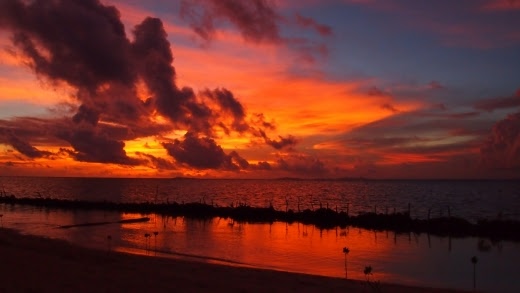
Watch amazing sunsets with a cold beer, at our private jetty.
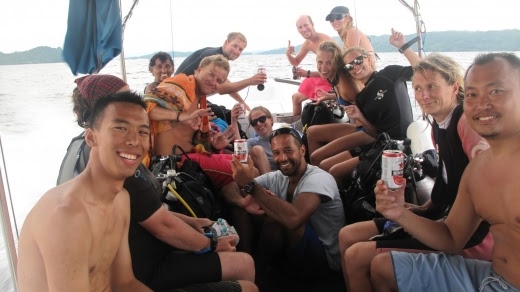
Some ex-volunteers and staff heading out to Daves Bar for a nice BBQ on a deserted beach.....what ever happened to Daves bar...anyone???.
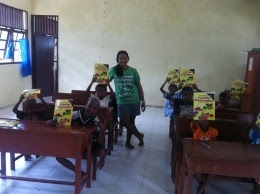
Money from volunteers expedition fees buys new English school books for Arborek kids.
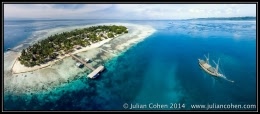
The Barefoot Conservation basecamp is located on Arborek island, Raja Ampat.
Allie Meyers
I had an amazing experience during my 8 weeks of volunteering with Barefoot Conservation in Raja Ampat. Barefoot gave me the opportunity to enjoy the local communities culture, teach local children english, through the marine science and survey work I learned a substantial amount about these bio diverse ecosystems while contributing to the conservation of them, and i was also able to dive in some of the most pristine reefs in the world, while living in paradise.


Barefoot Conservation's Mission & Goals
Mission:
Barefoot Conservation's mission is to work in partnership with the Raja Ampat local government, local Papuan Communities and stakeholders, to protect the coral reefs of Raja Ampat and the communities that rely on them.
This partnership is bonded by a willingness to make a real difference, and the understanding that research, survey dives and Marine Protected Areas cannot work unless accompanied by education and the sustained alleviation of poverty.
Our projects are designed to work at a grass roots level, thus making a real difference to real people, and a difference that each volunteer can see and be a part of.
Goals:
- To conduct marine underwater surveys using the Reef Check methodology, collecting data, for the use in advising local government, local communities and other NGO partners, on the health of coral reefs and marine life in Marine Protected Areas (MPA's).
- Produce a local Manta Ray Identification (ID) database, through underwater manta ray surveys. Sharing collected data with local government and NGO partners.
- Monitor the number of Crown of Thorns starfish (COTs) in the region, undertaking COTs removal dives during large outbreaks.
- Undertake educational programmes on environmental issues, sustainable fishing techniques (if necessary) and the economic benefits of MPA's.
- Increase quality of life and alleviate poverty in local communities, through our community projects - Education, Waste Management, Health Clinics, Family Planning, Dental Hygiene, Renewable Energy.
- Encourage entrepreneurial attitudes to deter from unsustainable destructive activities like Shark finning, Manta Ray gill raking or dynamite fishing.
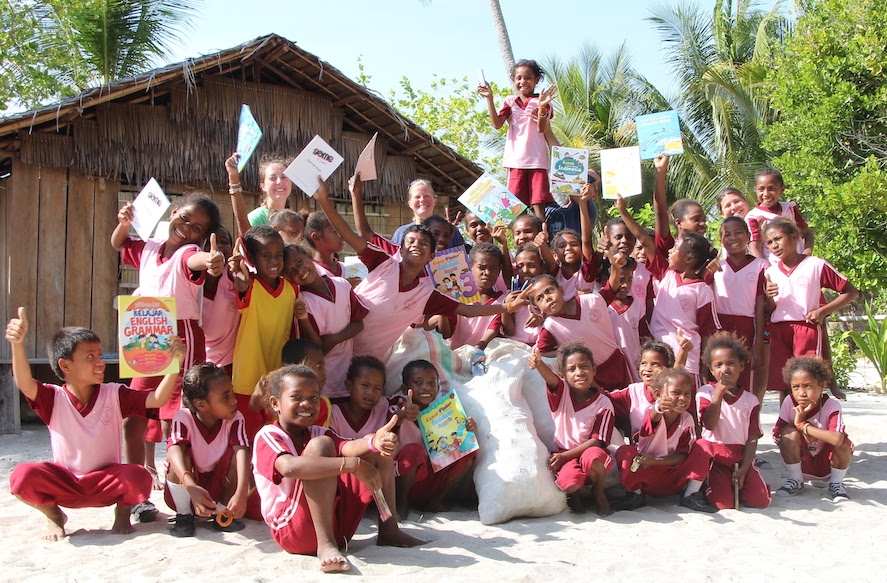
Barefoot Conservation's Waste Management Programme
Barefoot Conservation Beach Clean- Maybe Less Glamorous but Still Incredible Rewarding
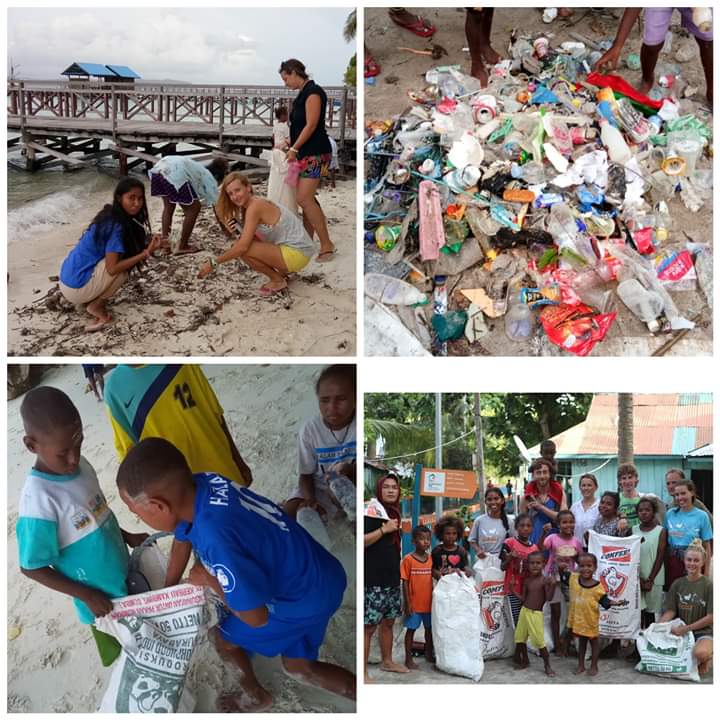
One of the greatest threats facing our oceans today is plastic waste, and it seems that there are few, if any, places left in the world that are unaffected by this issue. A major problem is with plastic wastes such as water bottles, sweet wrappers and plastic bags. They can take decades to degrade and even after this point they can remain within ecosystems as Nano-Plastics. Although beach clean ups may be less glamorous than releasing baby turtles, science diving and manta ray spotting, they are just as important, if not more important than all of these other activities.
Many marine creatures are often seen taking bites of plastic, before realizing what it is and spitting it out. Some however do not realize until it’s to late, this is a particular problem for many sea turtles such as the Leatherback who mistake plastic for one of their food sources jellyfish. Simply collecting the waste that washes up on the beach can have a huge impact on reef ecosystems, helping to prevent coral damage, ingestion by marine creatures and the release of harmful chemicals once the trash eventually starts to degrade.
Volunteers at Barefoot Conservation are asked to help out with beach clean-ups as often as possible. This not only sets a great example to the local community, but also allows participants to see the good they are doing by physically removing rubbish from the environment.
Anemone fish are omnivorous and can feed on undigested food from their host anemones.
More...
Barefoot Conservation's Education Programme
English Lessons
Hello, Mister! How are you?!!!
That is what came out of a young Papuan boy’s mouth two days after his first English lesson with Barefoot Conservation. Sitting in his father’s boat during a slow ride on a fine Saturday afternoon, the boy waved and shouted the same greeting over and over again to BC staff. If you were his teacher, how would you feel? Happy? Of course. Proud? Most definitely.
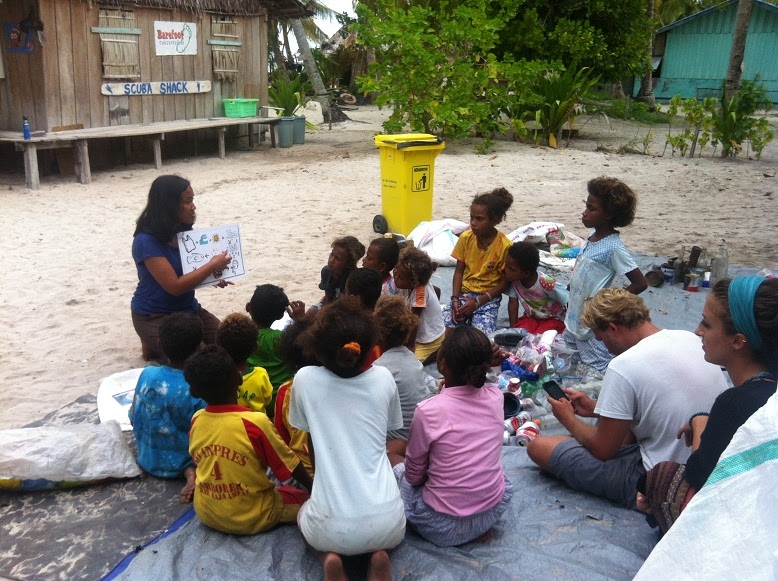
One of BC’s community work programs is to run English courses both for children and adults. Taught in a friendly, easy-going environment, we aim to improve the Papuan children's English skills to help their chances of qualifying for higher education. And the adults to communicate better with the tourists they encounter through their local businesses (village shop, homestays, snorkeling tours etc..). Classes are run separately between children and adult and they include writing, listening, reading, and speaking. To make it easy to grasp, examples and exercises are made such that they relate to every-day life in Raja Ampat.
Our staff, Desiree, has performed two children sessions on Alphabets, Numbers 0-10, and Greetings. How many students would you expect to attend the first session? 10? 20 maximum? Exactly her thought but surprise, surprise! Almost 30 students showed up ranging from Year 1 to Year 7. All in one class. Worse, there were only enough notes for 20 students which in the end had to be shared between them (after all sharing is an act of love, isn’t it?). They were shy at first and after a quick Hangman session, Desiree won their hearts. Never in her life has she had students learning with such excitement. After nearly 1.5 hours of teaching, she almost lost her voice so that was the end of Session 1. Judging from how the students responded to the lesson, they appeared to be more excited in English in Maths (no offense to all Maths teachers out there).
Moving on to the second session three days after the first, Desiree did a quick review on the alphabets and numbers with a game. She wrote random letter-number combinations on the blackboard such as AB78, H2LK, etc. She then divided the class into two groups and each team pointed a member to race against the other team member to the blackboard and find the combination Desiree previously spelled. So, there it was. The battle between the Lion and the Dolphin began (of course our beloved, aquatic mammal won!) The game was followed by listening, reading, and speaking exercises. The students were actively involved in all parts of the course. Like the first session, the second went very well and again, Desiree almost lost her voice at the end of the day. No pain, no gain, right?
Having students answering questions so loud and clear all together is an indication they want to learn and it gives us hope that these young students are capable of so much more. We believe if they are given the right educational support e.g. improved facilities and skillful teachers, they will be able to compete with other students from other states in Indonesia.
Well done, kids! See you soon for session 3.
Math Lessons
When Barefoot undertook its first surveys of the Yanbuba village community, we surveyed various members of the community across a broad demographic. It soon became apparent from the results, that a good education for the children was a very high priority for the community. So it came as no surprise to us that after English lessons, other school subjects were high up on the priority when we analysed the results.
Not long after our surveys the Kalibia team came to visit Yanbuba village to run a conservation education day. The Kalibia team (who were sponsored by Conservation International) sail around various villages through out Raja Ampat educating the children about conservation and the delicate coral reefs that live on their doorstep.
Barefoot Conservation was invited by the Kalibia team to join them for the day to help out with the programme. It was during some of the fun games that Desiree one of our community staff team asked some of the kids how many of them were left in their team now that 3 had join another team. Desiree was shocked at just how many of the children struggled with this simple question. It became obvious to us that Barefoot would need to expanded its education programme to include Maths as well as English lessons.
After a meeting with the Head of Schools for the region, Barefoot was given permission to run some classes during school time, the first of which was year 6 maths. We were asked by the Head of Schools and the local school teachers in Yanbuba village if we could help out with year 6 maths first, as they will be taking their national exams in May.
Desiree our Community Manager got straight to work burning the midnight oil to produce lesson plans for the year 6 classes. Fractions were her first port of call, as this was the current level the year 6 children should have been at from looking at the school syllabus. Desiree soon found herself going back over multiplication and division with the children as they struggled with these parts to solve the fraction equations she had set them on the board.
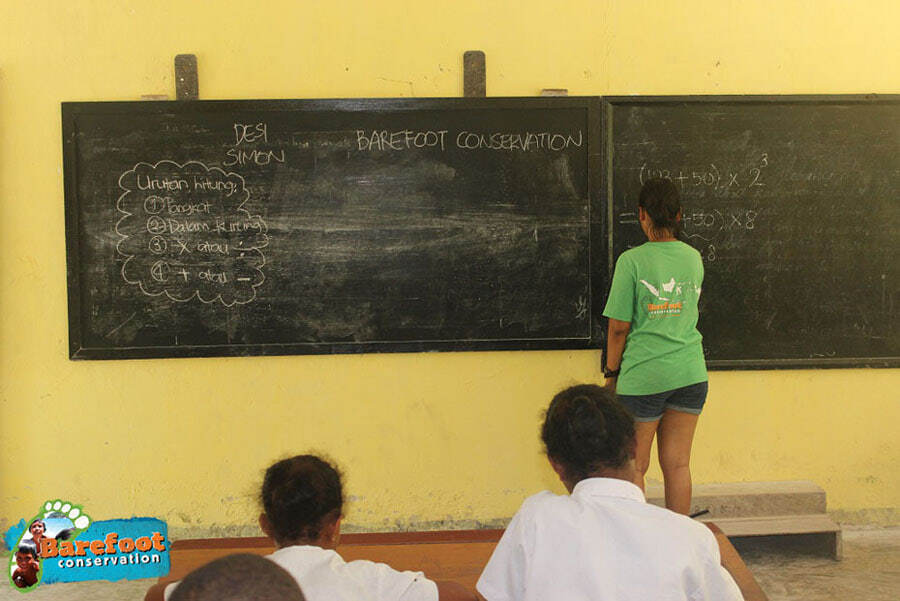
Desiree now knew she had her work cut out for her, but we had made a start and we had started to make a difference, and although we all knew it was a long road ahead, we were all pleased to be making a difference to these children's education.
When you join a Barefoot Conservation expedition you will help out with this rewarding education programme, your expedition fee goes towards helping these children get a better education and providing new school materials!
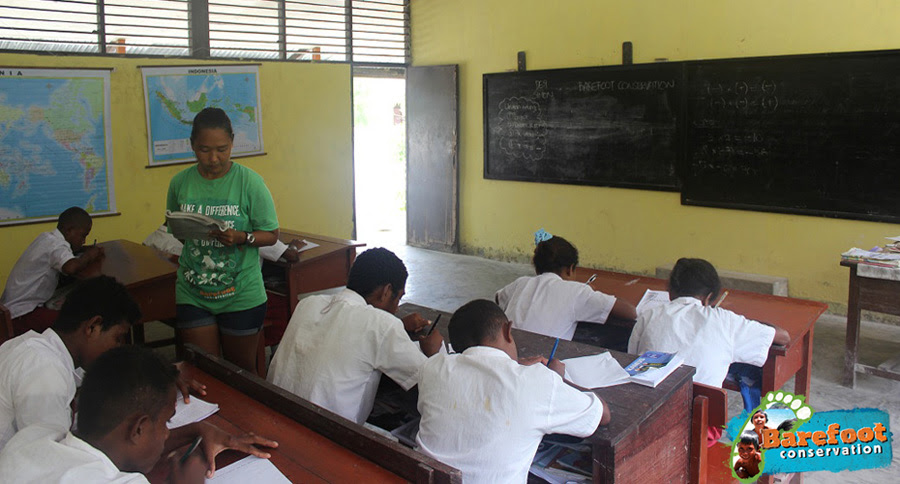
Test out your old fraction knowledge and see if you could solve the equation in the picture below (no calculators allowed as the Yanbuba school kids dont have them!): -
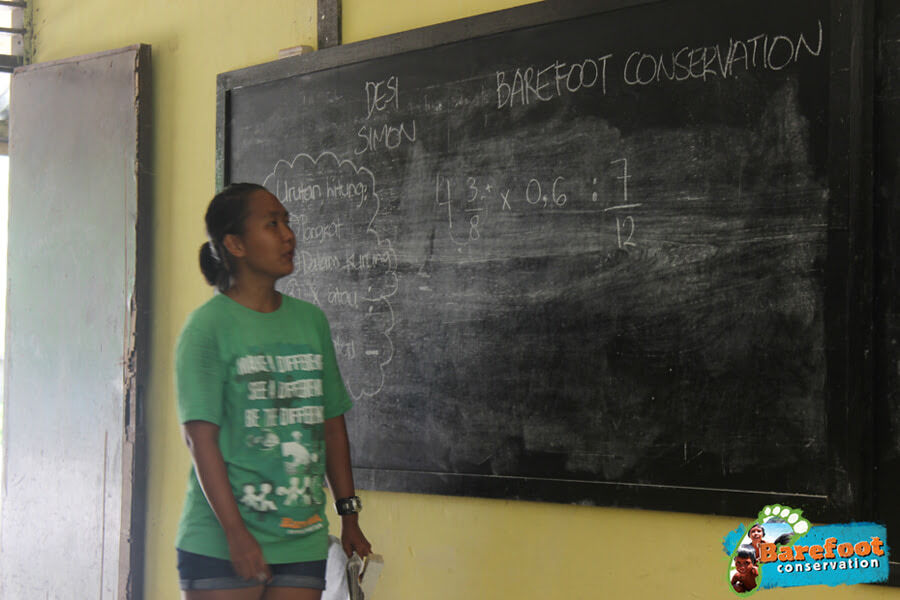
Answer is below, no cheating now.....
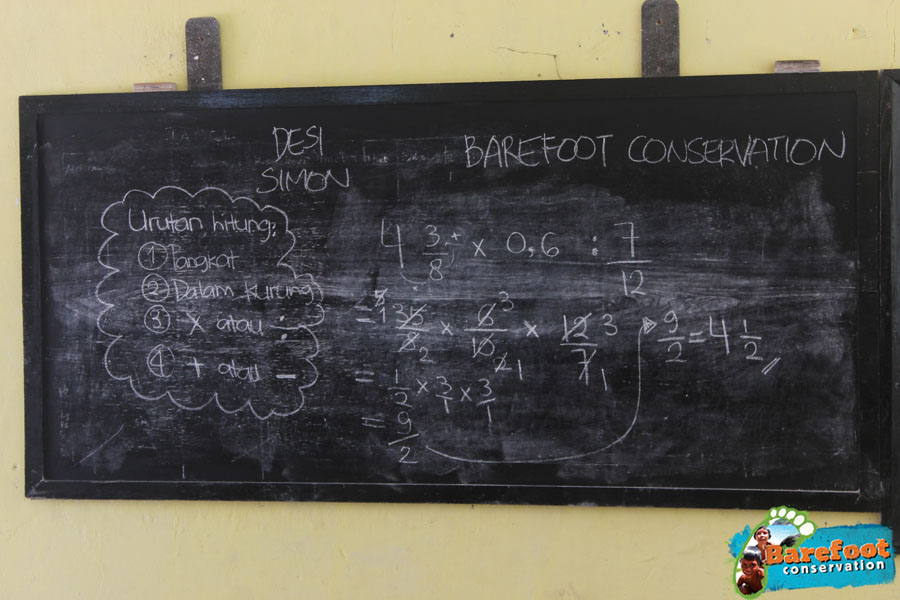
Well done to all of you that got it correct! Ans= 4.5
Barefoot Conservation meets the mayor of Raja Ampat

When Barefoot Conservation first came to Raja Ampat, we organised meetings with the Head of Tourism Board of Raja Ampat, Mr Yusdi in Waisai. We introduced our organisation and explained the community and science work that we would like to undertake in the region.
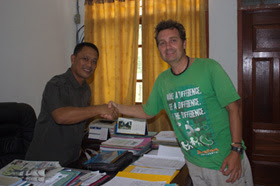
Mr Yusdi seemed to be very excited about Barefoot Conservation and he even arranged a meeting with the Major of Raja Ampat, Drs Marcus Wanma M.Si.We never expected such a meeting would take place so soon but since it was already planned (and it would be rude to say no to the major), we agreed to see him on the following week.
On the day of the meeting with the major, we put on our smart outfit which meant Barefoot T-shirt, trousers and shoes! Mr Yusdi greeted us and introduced us to the Head of the Homestay Association, Mr Paulus. After a brief conversation and a quick contact exchange, Mr Paulus left and the rest of us walked to the major’s office which was located just outside his office building. As soon as we entered the major’s room, we could feel a sense of power there. Massive room with classy furniture and carpeted floor welcomed us. Not to mention the gigantic statue of Jesus giving his blessings and plasma TV!
Mr Yusdi nervously introduced us to the major right away and we got to business. Simon then gave a short presentation on the missions of Barefoot Conservation. We essentially stated that we are here to help the community in many different aspects such as education, health services, diving safety, and conservation while still learning the culture and custom of the Papuan community. We also mentioned that the participation of stakeholders is the key to the success of our projects. The major accepted Barefoot Conservation, welcomed us to the region and gave his approval to start running our projects.
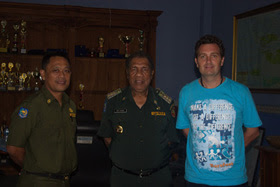
Both the major and Mr Yusdi eagerly offered their full support with our work and arranged to write us a letter of recommendation. We then said goodbye after taking some pictures to mark the event.
Barefoot's volleyball team takes on challenge from local staff

It was late afternoon on a sunny Saturday, and the scene was set for an epic volleyball match between the Barefoot Braves and the Raja Ampat Raiders.
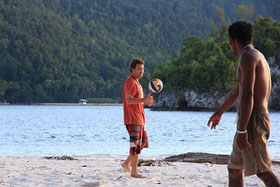
The challenge was thrown down by Dany the Barefoot dive boat driver and Simon accepted, the prize....the most sort after item on the island....a cold case of beer!!
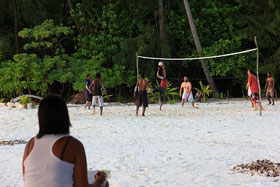 Tensions were high during the warm up, with such a major prize up for grabs, Desiree Barefoot's Science and Community intern kept score, of a first to 25 points, best of 5 set format.
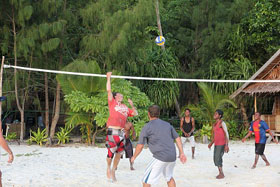 The Barefoot team got off to a flying start, with their unorthodox style at first confusing the opposition, leaving Theo the sites boat/engine mechanic to show off his YMCA skills.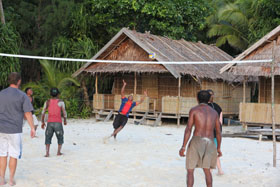
However Barefoot’s good start did not last long and after trading spikes and points, it soon become apparent Barefoot would need to bring in some ringers!
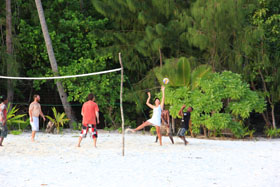 So we called up Raymond (Mangkur Kodon homestay manager), Dany and Maria Sharapova (aka Claire one of the volunteers) to help bolster the baseline defence.
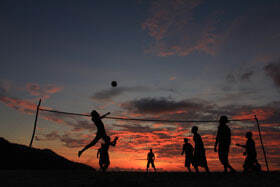 Sadly this did not help the Barefoot team and as the game went on into the night with the sun setting behind us, the Raja Ampat Raiders took control, the glory and the holy grail of a cold case of beer!
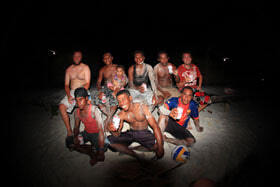 All was not lost however as both teams chilled out with a cold beer as the sun set and discussed exaggerated stories of how high we all jumped!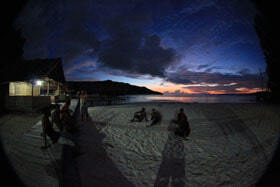
One nil to the Raja Ampat Raiders, but re-match accepted for next Saturday! We urgently need some 6 ft tall volunteers!!!
CREATURE WATCH
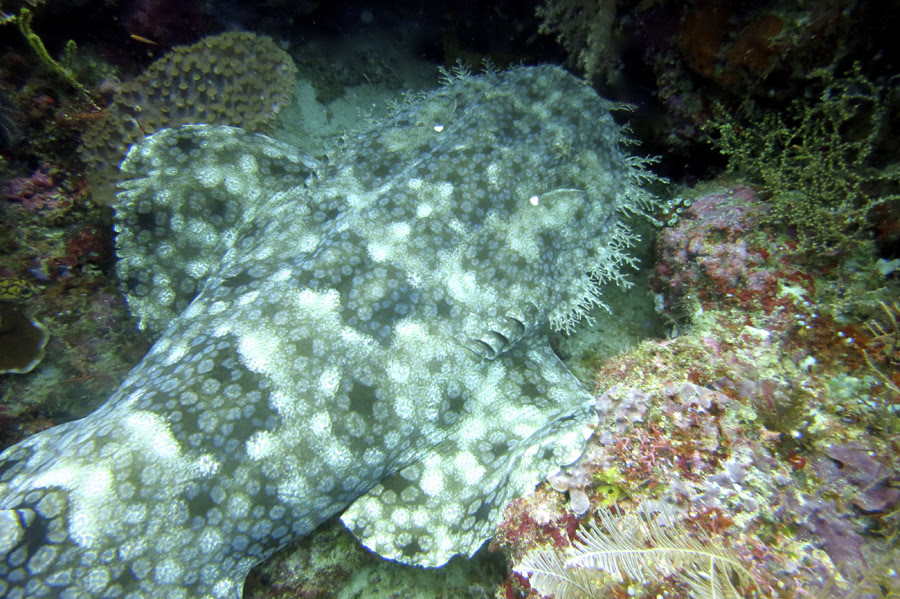
Ornate Wobbegon - Orectolobus ornatus
Kingdom: Animalia Phylum: Chordata Class: Chondrichthyes Sub-class: Elasmobranchii Order: Orectolobiformes Family: Orectolobidae Genus: Orectolobus Species: Orectolobus ornatus
Ornate Wobbegon are commonly found on coral reefs but are often over looked by divers because of their highly camouflaged bodies. They are predominantly ambush predators who lye in wait for their pray, so diver’s who aren’t paying attention to where their going had better watch out! Some species of wobbegon have been observed sneaking up on their pray from a distance. They are able to reach a maximum length of approximately 3 meters and are ovoviviparous meaning that eggs are retained within the female shark in a brood chamber where the embryo is able to develop in relative safety feeding on a yolk sac.
Spot the Seahorse
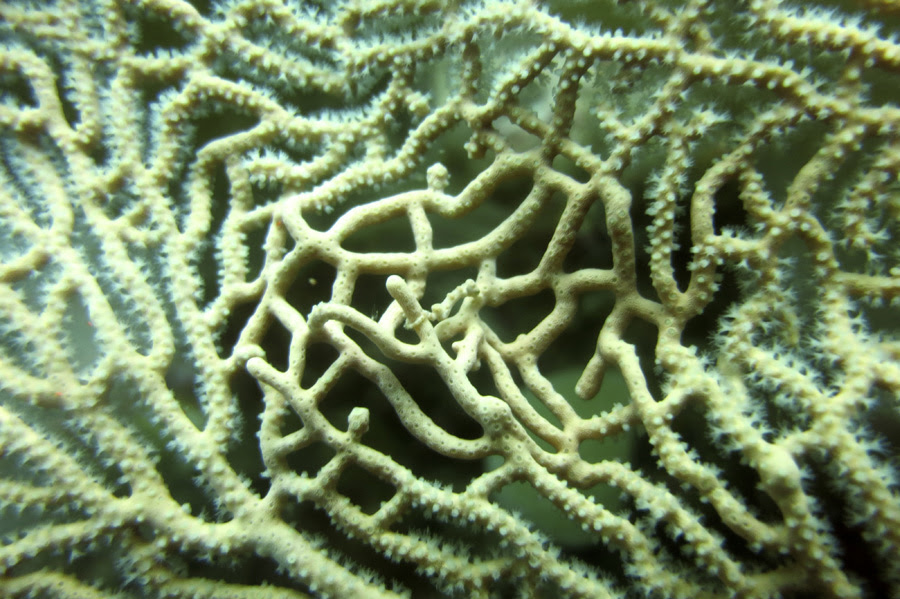
Denise's Pygmy Seahorse - Hippocamus denise
Kingdom: Animalia Phylum: Chordata Class: Actinopterygii Order: Gasterosteiformes Family: Syngnathidae Genus: Hippocampus Species: Hippocampus denise
Most likely due to its tiny size Pygmy seahorses have only been discovered within the last decade and very little is know about them still. Hippocampus denise is one of the smallest species measuring less than 2 cm in height and are thought to only live on certain gorgonian corals namely; Annella reticulata, Muricella and Echinogorgia, at depths ranging from 13–90 m (IUCN Red List). Current thinking suggests that they feed on the tissue of the gorgonian that they live on or on plankton brought to them on currents. Like other seahorses Pygmies are monogamous and ovoviviparous, where the eggs are carried with in the brooding cavity of the male while the female begins a new cycle.
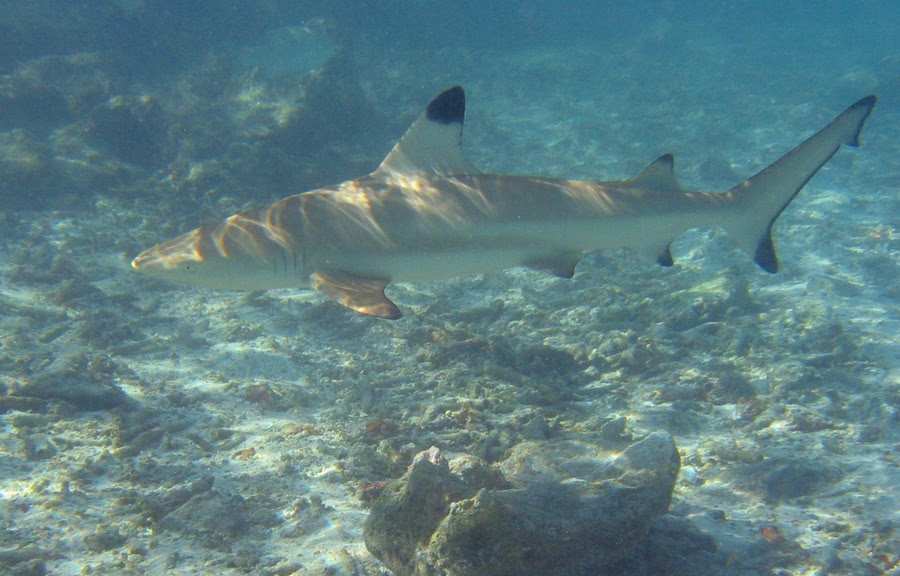
Blacktip Reef Shark- Carcharhinus melanopterus
Kingdom: Animalia Phylum: Chordata Class: Chondrichthyes Sub-class: Elasmobranchii Order: Carcharhiniformes Family: Carcharhinidae Genus: Carcharhinus Species: Carcharhinus melanopterus
A common occurrence around Barefoot Conservation's house reefs, blacktip reef sharks are usually seen gliding in to the distance by survey teams and on occasion have been know to come in for a closer look for a few lucky divers. Blacktips are considered small as far as sharks go reaching up to 1.8 meters in length. Their most distinctive features are the “black tips” on all of their fins, and are one of three sharks commonly seen in the Indo-Pacific, the other two being the grey reef shark, Carcharhinus amblyrhynchos and whitetip reef shark, Triaenodon obesus. Blacktip reef sharks like most species of sharks are hugely vulnerable to depletion because of their long gestation periods and small litter sizes. Typically they mature at eight years for a male and nine for a female who will gestate for about 10 months with a litter size of two to four pups.